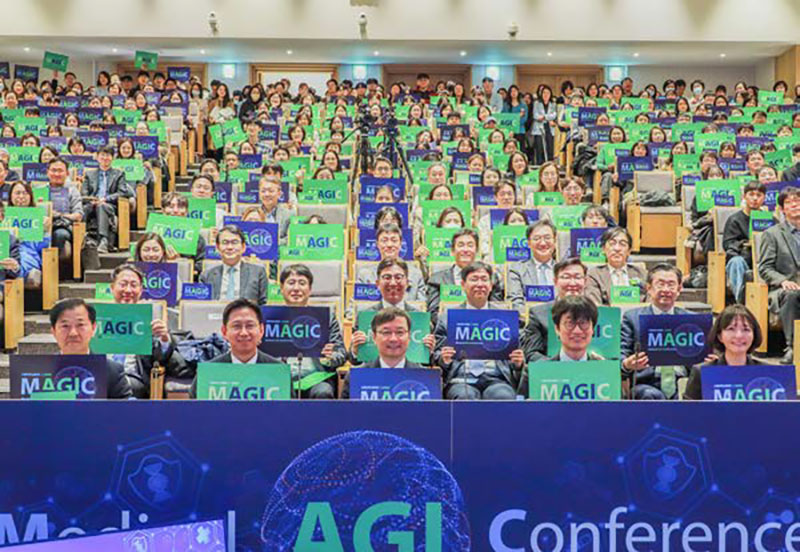
KMED.AI — KOREA’S FIRST SOVEREIGN MEDICAL LLM Seoul National University Hospital and Naver jointly unveiled KMed.ai at a Medical AGI (Artificial General Intelligence) conference held at SNUH — Korea’s first sovereign medical large language model, and a deliberate step away from dependence on foreign AI platforms. The launch drew the Minister of Science and ICT, the Vice Minister of Health and Welfare, Naver’s Chair, and SNUH’s Hospital Director.
KMed.ai is not a rebranded adaptation of an existing international model. SNUH’s Healthcare AI Research Institute developed an initial model from direct clinical experience, then refined it by integrating Naver’s AI technology with structured feedback from SNUH physicians. The result is a model trained on Korean clinical language, aligned with domestic medical guidelines, and built to reflect the reasoning patterns Korean clinicians actually use. On the Korean Medical Licensing Examination (KMLE) mock test it scored an average of 96.4 points — the highest ever recorded by any AI system on that benchmark. KMed.ai is designed not as a replacement for clinicians but as a support tool: helping doctors process complex clinical scenarios faster, write EMR notes more efficiently, and surface relevant evidence at the point of care.
TWO OPEN-SOURCE SPECIALIST MODELS RELEASED TO THE WORLD In a separate initiative, SNUH’s Healthcare AI Research Institute — supported by the Ministry of Science and ICT’s AI Computing Support Programme — released two specialist medical AI models as open source, freely available to clinicians and researchers globally via the Korea Health Data Platform (KHDP) and Hugging Face. The first, mvl-rrg-1.0, is a radiology reporting model that analyses chest X-ray images and automatically generates reports. It connects past and current images to detect disease progression over time. Trained on more than 360,000 publicly available medical images, it achieved ROUGE-L 34.1 and BLEU-4 18.6 — internationally top-tier performance for automated radiology report generation. The second, hari-q2.5-thinking, takes on the harder problem of clinical reasoning. When a patient presents with overlapping symptoms simultaneously, this model is designed to reason through the patient’s history, weigh possibilities, and guide what to investigate next. It achieved 89% accuracy on KMLE mock testing. SNUH plans to expand into 17 specialty-specific variants and develop a multi-agent system in which multiple AI models collaborate to produce a synthesised clinical report for the physician.
KMED.AI · KMLE MOCK SCORE 96.4 Highest ever by any AI system on the Korean Medical Licensing Exam mock
OPEN-SOURCE · RADIOLOGY mvl-rrg-1.0 Chest X-ray auto-reporting · Temporal comparison · ROUGE-L 34.1 · BLEU-4 18.6
OPEN-SOURCE · CLINICAL REASONING hari-q2.5 89% KMLE accuracy · Differential diagnosis · 17 specialty variants planned
“ I hope KMed.ai becomes a model case of sovereign AI that most deeply understands Korea’s medical environment and medical law. ” — Naver Chair, Medical AGI Conference
|