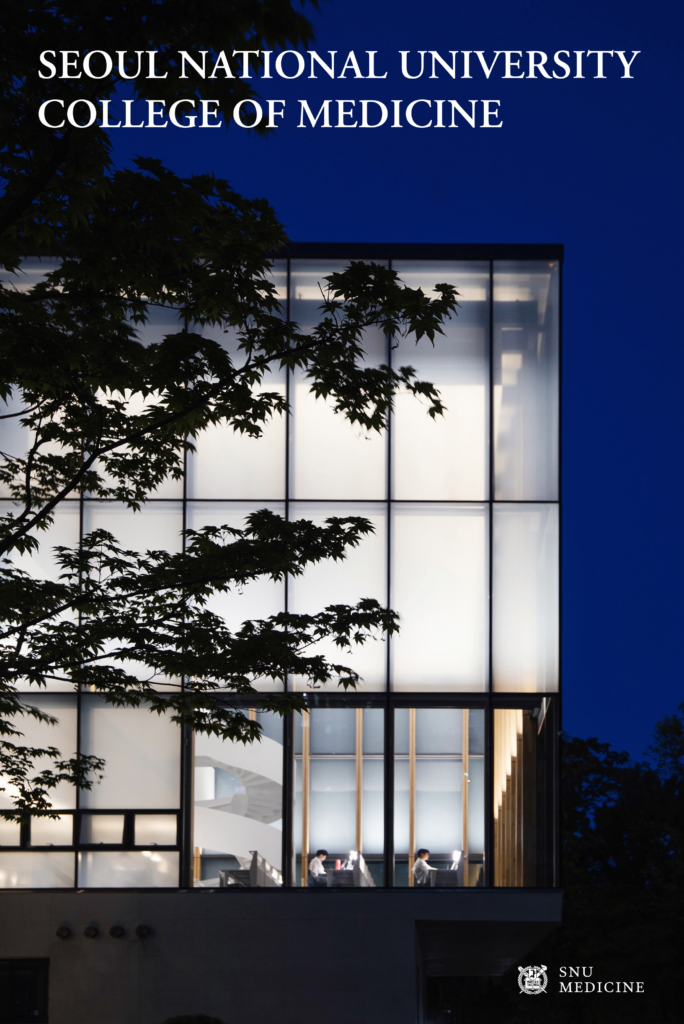
Born in an era of transformation
In 1899, on a hillside in Seoul where a dynasty was giving way to an empire and an empire to modernity, Emperor Gojong signed into being Korea’s first formal institution of medical education. The Uihakgyo — the Imperial Medical School — was a statement of intent: that a sovereign nation would educate its own healers, in its own language, by its own hands. From that modest beginning, Seoul National University College of Medicine has grown into one of the preeminent medical schools in Asia. This inaugural issue of SNU Medicine is our invitation to look back at where we came from, and forward to where we are going.
The founding of the Uihakgyo was not an isolated act. Ji Seok-young, its first principal, was a pioneering physician who had already introduced smallpox vaccination to Korea. The school he led was tasked not merely with producing doctors, but with reimagining what Korean medicine could be — rigorous, evidence-based, and sovereign.
The decades that followed were turbulent. The school was merged, renamed, and reorganised under successive governments: first into the Daehan Medical Institute in 1907, then into Gyeongseong Medical College during the Japanese colonial period. Through each transformation, the institution’s core mission — training Korea’s physicians and advancing its medical knowledge — endured.
“ We have strived, for 125 years, to be the best in education, research, and patient care — and to lead medical advancement not only in Korea, but across East Asia and the world. ”
— SNU Medicine, College Overview
Then and Now: The Yeongeon Campus
< The campus, c. 1960 >
< The campus today >
The arched brick buildings that defined the campus in the 1960s remain a defining motif of the Yeongeon Campus today. In 1946, Seoul National University was formally established, and the medical school found its permanent home in Daehangno — the same tree-lined neighbourhood in Jongno that has housed Korean medical education for over a century.
A research powerhouse
Today, SNU Medicine is home to roughly 520 faculty, more than 2,000 students, and approximately 1,000 principal investigators whose work spans oncology, genomic medicine, infectious disease, medical AI, neuroscience, and beyond. In 2022, the Academic Ranking of World Universities placed SNU Medicine first in Asia in the field of medicine; QS World University Rankings 2026 rank it 36th globally.
The numbers behind that standing are striking: over 56,000 research publications, more than 870 active clinical trials, and annual R&D funding running into the hundreds of billions of won. Investigators at the college have published in the New England Journal of Medicine, Nature, Cell, and JAMA. The college operates 20 dedicated research facilities and 4 core laboratories.
Alumni of SNU Medicine have shaped medicine on a global scale. Jong-Wook Lee served as Director-General of the World Health Organization. Ho-Wang Lee discovered both the Hantan and Seoul viruses. Chung Yong Kim isolated the hepatitis B virus from serum in 1973 and developed Korea’s first hepatitis B vaccine — a contribution that protected millions.
Notable Alumni
Education reimagined for the next century
In 2025, Dean Jae-Joon Yim — the college’s 38th dean — took office, and with him came an announcement that marks the most significant structural shift in SNU Medicine’s educational model in a century. Beginning in 2027, the longstanding two-stage system — a two-year premedical course on the Gwanak Campus followed by four years of medical school on the Yeongeon Campus — will be replaced by an integrated, unified six-year MD programme.
The change is not merely administrative. It reflects a deliberate philosophy: that the artificial divide between “pre-medicine” and “medicine” has outlived its purpose. The new curriculum will weave together the sciences, clinical skills, humanities, and research from the very first year, producing physicians who are scientists, clinicians, and leaders simultaneously.
A vision for what comes next
In 2019, on the 120th anniversary of the Uihakgyo, SNU Medicine declared its guiding vision for the decade ahead: Beyond & Ahead. Built on three strategic pillars, the vision commits the college to creative long-term research, transparent institutional governance, and an active role in improving health worldwide.
1. Sharing Value : Extending the benefits of medical knowledge to society at large — locally, nationally, and globally. 2. Pursuing Excellence : Prioritising long-term, creative research over short-term metrics. Building structural support for collaborative and convergent inquiry. 3. Global Contribution : Training medical professionals in developing nations and partnering with 115+ institutions across 35 countries. That global commitment is already tangible. SNU Medicine holds MOUs with over 115 institutions in 35 countries. The Lee Jong-Wook Global Medical Center, established in 2012, works to train medical professionals in developing nations — a direct expression of the belief that knowledge accumulated over 125 years carries an obligation beyond Korea’s borders.
The affiliated hospital network — anchored by Seoul National University Hospital with its 1,700-plus beds — ensures research and education remain tethered to the realities of patient care. The affiliated hospital network (Seoul
National University Hospital; Bundang Seoul National University Hospital; Seoul Metropolitan Government Boramae Medical Center; National Traffic Injury Rehabilitation Hospital; Sheikh Khalifa Specialty Hospital;)
This is our first issue. It will not be our last. Inside SNU Medicine is a publication built for a community of healers, researchers, educators, and students who believe that medicine — honestly practised, rigorously pursued, and generously shared — is one of the most consequential things human beings can do for one another. We are glad you are here.
|