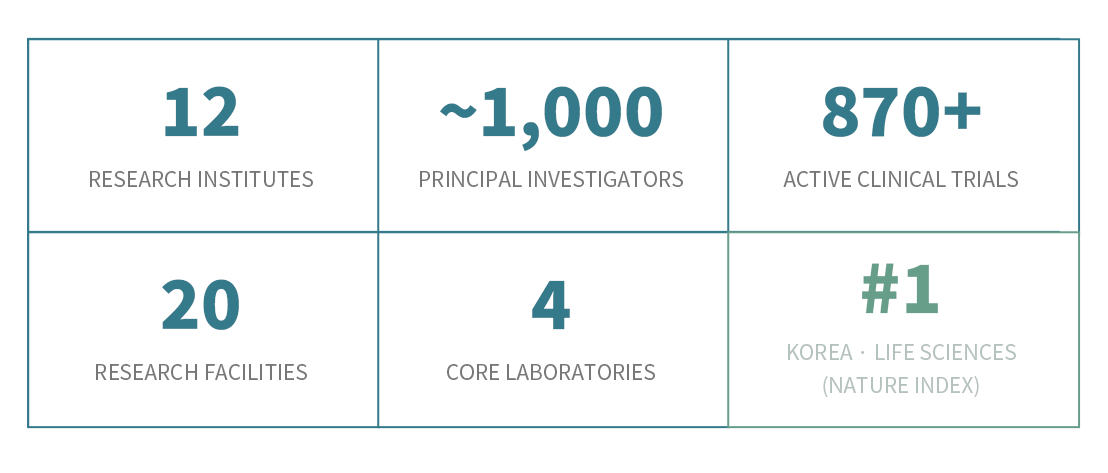
Seoul National University College of Medicine does not merely train physicians. It trains medical scientists — people capable of generating the knowledge that medicine will run on for the next generation. That ambition is not rhetorical. It is institutional, embedded into a research infrastructure of twelve dedicated units, twenty research facilities, four core laboratories, and roughly one thousand active principal investigators working across the full breadth of biomedical science. The numbers are striking on their own: in 2018, investigators at SNU Medicine published more than 5,600 SCI-level papers. By 2025, that trajectory had continued upward, with the Genomic Medicine Institute alone logging over 450 indexed publications. More than 870 major clinical trials run concurrently from the affiliated hospitals. The Nature Index ranks SNU Medicine first in Korea in Life Sciences and Cancer Research. These are not the outputs of a single ambitious department — they are the product of a deliberately constructed ecosystem. “ The ultimate goal is to develop innovative, fundamental technology and apply it to clinical practice — closing the loop between the bench and the bedside. ” SNU Medicine Research Mission
THE RESEARCH UNITS
Twelve research institutes and support centres form the backbone of SNU Medicine’s research infrastructure, each with a distinct mandate and a record of sustained output.
SNU Medical Research Center The anchor institution for basic and translational research, housing the Genomic Medicine Institute and coordinating cross-disciplinary programmes across the college.
Cancer Research Institute Korea's leading cancer research unit, focusing on molecular oncology, immunotherapy, and translational cancer biology with direct links to the SNUH Cancer Hospital.
Institute on Aging Addressing Korea's rapidly aging population through research into neurodegeneration, age-related metabolic disease, senescence biology, and longevity medicine.
Wide River Institute of Immunology (WRII) A dedicated immunology campus studying autoimmune disease, immune regulation, and the molecular basis of immune-mediated conditions.
Liver Research Institute One of Asia's foremost liver research centres, pioneering work in hepatocellular carcinoma, viral hepatitis, and transplant medicine.
JW Lee Center for Global Medicine Bridges research and global health delivery, running capacity-building programmes across Asia, Africa, and Central Asia while generating evidence on infectious disease and health systems.
Institute for Health and Unification Studies A unique mandate: studying the health landscape of North Korea and preparing for the medical challenges of potential Korean reunification.
SNUH Biomedical Research Institute The translational arm embedded within Seoul National University Hospital, conducting investigator-initiated trials and bridging hospital data with laboratory discovery.
Office of Policy Development for Healthy Society Producing evidence-based health policy research with direct engagement with Korea's Ministry of Health and national public health bodies.
Biomedical Center for Animal Resource Development & Institute for Experimental Animals Provides state-of-the-art animal model infrastructure, including germ-free and genetically modified animal platforms, for preclinical research across all departments.
Core Research Facilities Four shared core labs — genomics, proteomics, imaging, and cell biology — making cutting-edge instrumentation available to all SNU Medicine researchers and collaborators.

RESEARCH OF THE MONTH 2025 · IMPACT FACTOR > 40
Each month, SNU Medicine spotlights research that exemplifies the college’s commitment to scientific creativity and clinical impact. The following two highlights from 2025 were published in journals with an impact factor above 40 — representing the highest-visibility science to emerge from the college in the past year.
CARDIOLOGY · RESEARCH OF THE MONTH 2025 · The Lancet IF 168.9 Dual antiplatelet therapy after PCI according to bleeding risk — the HOST-BR trial The HOST-BR open-label, multicentre randomised clinical trial — led by SNU Medicine cardiologists — established new evidence for tailoring the duration of dual antiplatelet therapy after percutaneous coronary intervention based on individual bleeding risk. The trial’s findings are directly informing revisions to international cardiology guidelines, and represent one of the highest-impact clinical trial results to emerge from a Korean institution in recent years.
PULMONARY MEDICINE · RESEARCH OF THE MONTH 2025 · Signal Transduction and Targeted Therapy IF 52.7 Parathyroid hormone–related protein is a therapeutic target in idiopathic pulmonary fibrosis This study identified parathyroid hormone–related protein (PTHrP) as a previously unrecognised driver of fibrotic remodelling in idiopathic pulmonary fibrosis — a progressive and frequently fatal lung disease with limited treatment options. By demonstrating that targeting PTHrP signalling can attenuate fibrosis in preclinical models, the work opens a new therapeutic direction for a condition that currently lacks effective disease-modifying therapies.
TOWARDS A PHYSICIAN-SCIENTIST CULTURE
What distinguishes SNU Medicine’s research output is not volume alone — it is the deliberate integration of clinical and scientific training. The Physician-Scientist Training Programme, launched to support clinician-scientists from MD student through to post-doctoral fellow, reflects a conviction that the most consequential medical advances come from researchers who can move fluently between the laboratory and the ward. This culture also extends internationally. The college’s SCI-level publications increasingly carry co-authors from partner institutions in North America, Europe, and across Asia — a reflection of the MOU network described elsewhere in this issue, and of a deliberate strategy to ensure that SNU Medicine’s science is tested and amplified by the global research community. As Korea faces the epidemiological challenges of one of the world’s most rapidly aging societies — and as the country’s biohealth industry emerges as a major economic sector — the research units of SNU Medicine are positioned to generate not only knowledge, but the trained scientists and validated therapeutics that the next era of Korean and global medicine will require.
Full research profiles and publication lists are available at the Elsevier Pure Research Portal: snu.elsevierpure.com/en/organisations/college-of-medicine. Research of the Month archives: medicine.snu.ac.kr/en
|