Professor Hyung Jin Choi
This research indicates that GLP-1 receptor agonists effectively treat obesity by enhancing preingestive satiation, a mental and physical feeling of fullness that occurs before eating. By studying both humans and mice, scientists identified a specific neural pathway in the dorsomedial hypothalamus (DMH) that manages this preemptive response to food cues. Experimental manipulation of these DMH neurons proved they are both necessary and sufficient to trigger satiation and curtail overeating. Advanced imaging revealed two distinct cell populations: preingestion neurons that activate during food seeking and ingestion neurons that respond during the act of eating. The study concludes that GLP-1 drugs work by heightening the activity of these hypothalamic circuits, particularly when an individual encounters food stimuli. These findings offer a new understanding of how metabolic medications influence the brain to regulate appetite and eating behavior.
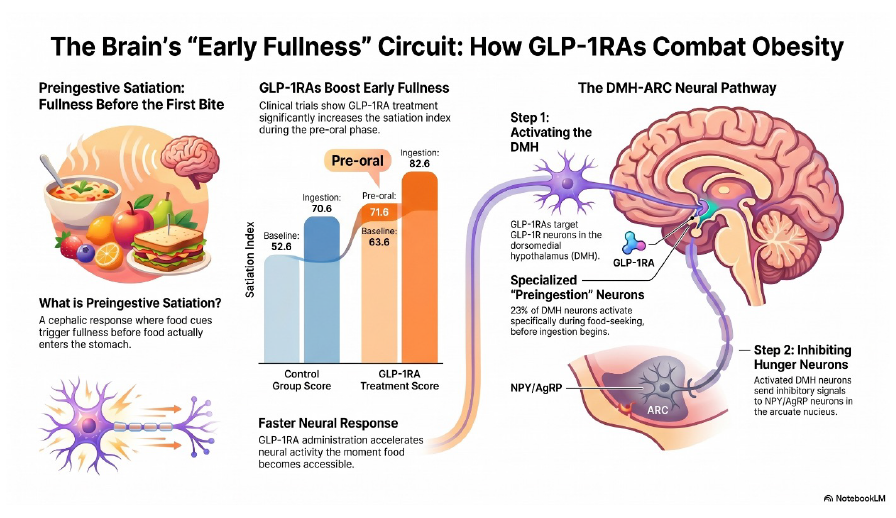
Decoding the Anticipatory Brake: SNU Researchers Reveal How GLP-1 Agonists Wire the Brain for Satiation Glucagon-like peptide-1 receptor agonists (GLP-1RAs) have revolutionized obesity treatment, but the precise central mechanisms driving their profound effects on appetite have remained elusive. Recently, a landmark study published in Science by a research team led by Seoul National University College of Medicine—including Dr. Hyung Jin Choi, Kyu Sik Kim, and Joon Seok Park—has mapped the exact neural circuits responsible for this phenomenon. The study reveals that GLP-1RAs trigger "preingestive satiation," a preemptive feeling of fullness that occurs before food is even consumed, orchestrated by a specific region in the hypothalamus. The research elegantly bridges clinical observations in humans with advanced neurocircuitry mapping in mice. In a phase-specific clinical trial involving individuals with obesity, the SNU team discovered that GLP-1RA treatment significantly raised the satiation index during the preingestive phase—the period after food-cue exposure but before actual ingestion. Essentially, patients experienced heightened fullness simply by anticipating food, altering their cognitive response to food cues. To uncover the neurobiological roots of this clinical finding, the researchers turned to transgenic mouse models. They pinpointed GLP-1 receptor (GLP-1R) expressing neurons in the dorsomedial hypothalamus (DMH) as the master regulators of preingestive satiation. Using cutting-edge in vivo calcium imaging and fiber photometry, the team observed that DMH GLP-1R neurons surge in activity the moment food becomes accessible and during food-seeking behavior, acting as an "anticipatory brake" on hunger. Taking it a step further with microendoscopic single-cell dynamics, the SNU team identified two distinct neuronal clusters: "preingestion neurons" that anticipate food and "ingestion neurons" that respond during active eating. Furthermore, through optogenetic manipulation, they proved these neurons are both necessary and sufficient to control eating behavior. Activating DMH GLP-1R neurons immediately terminated eating, while inhibiting them caused mice to prolong their meals. Crucially, the researchers mapped the downstream circuitry, demonstrating that these DMH neurons directly inhibit the hunger-promoting neuropeptide Y/agouti-related peptide (NPY/AgRP) neurons located in the arcuate nucleus (ARC). The systemic administration of GLP-1RAs was shown to potentiate this exact circuit, actively dampening the brain's innate hunger signals. Interestingly, the researchers also found that this DMH circuit extends beyond food, playing a multifaceted role in encoding thirst satiation to regulate water intake. For physicians, this study is highly significant as it fundamentally shifts our understanding of how anti-obesity medications alter food cognition. By demonstrating that GLP-1RAs do not merely signal the physical termination of a meal, but actively rewire the brain's anticipatory response to food cues, this research explains the robust clinical efficacy of these drugs in our modern, food-cue-rich obesogenic environment. Moreover, this breakthrough offers previously unexplored neural targets for the development of next-generation therapies for obesity and metabolic diseases. For the Seoul National University College of Medicine family, this publication stands as a proud testament to the institution's premier role in tackling global health crises, powerfully advancing translational medicine from the bedside to the bench and back again. |