Professor Bon-Kwon Koo
This study compared two different methods used to assist doctors during heart procedures for patients with partially blocked arteries. Researchers conducted a trial with over 1,600 participants to determine if using fractional flow reserve (FFR), which measures blood pressure and flow, was as effective as intravascular ultrasonography (IVUS), which provides detailed internal images of the vessel. The results revealed that FFR guidance was noninferior to IVUS guidance regarding major clinical outcomes like death, heart attack, or the need for repeat procedures over a two-year period. Notably, the FFR method led to significantly fewer stents being implanted compared to the ultrasound-guided approach. Despite these differences in treatment frequency, both groups reported similar improvements in their quality of life and chest pain symptoms. Ultimately, the findings suggest that both technologies are reliable options for managing intermediate coronary disease, though FFR may reduce the use of medical resources.
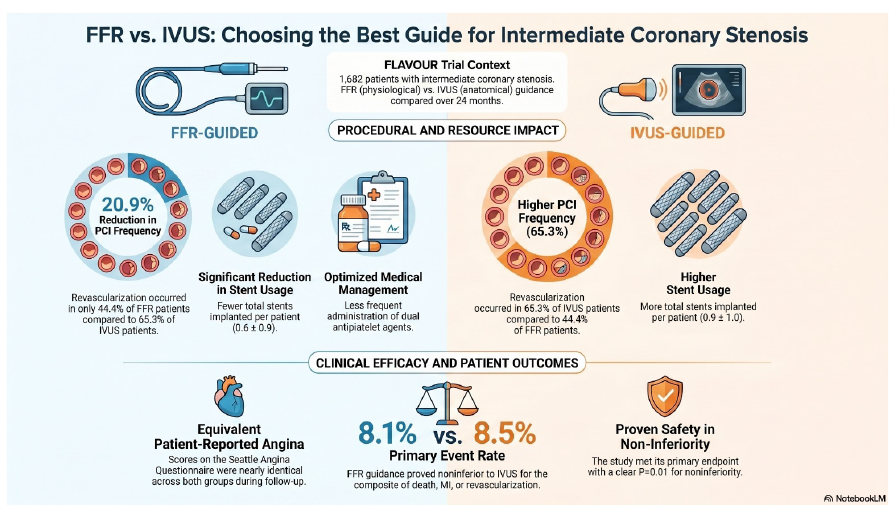
SNU Medicine Leads Landmark FLAVOUR Trial Published in NEJM, Redefining Coronary Intervention Guidelines In a major milestone for cardiovascular research, a team of investigators led by Seoul National University College of Medicine has published the results of the FLAVOUR trial in the New England Journal of Medicine. The groundbreaking study provides critical clinical evidence comparing the two most common adjunctive tools used during heart catheterization: Fractional Flow Reserve (FFR) and Intravascular Ultrasonography (IVUS). For years, cardiologists evaluating patients with intermediate coronary stenosis (arteries with 40% to 70% occlusion) have relied on either FFR, which measures physiological blood flow restriction, or IVUS, which provides detailed anatomical imaging of the vessel lumen and plaque. While both tools are highly effective, there has been a significant lack of data directly comparing the clinical outcomes of FFR-guided versus IVUS-guided procedures to determine the optimal strategy for patient care. To bridge this gap, Professor Bon-Kwon Koo, alongside SNU Medicine colleagues including Professors Jeehoon Kang, Doyeon Hwang, and Hyo-Soo Kim, spearheaded the FLAVOUR (Fractional Flow Reserve and Intravascular Ultrasound-Guided Intervention Strategy for Clinical Outcomes in Patients with Intermediate Stenosis) trial. This investigator-initiated, multinational randomized trial spanned 18 sites across Korea and China. The SNU-led team randomly assigned 1,682 patients to undergo either FFR-guided or IVUS-guided percutaneous coronary intervention (PCI). Notably, Seoul National University Hospital served as the central angiographic core laboratory, calculating SYNTAX scores and analyzing the raw physiological data for the FFR group. The experimental results revealed a remarkable shift in treatment efficiency. Patients evaluated with FFR underwent PCI (stent implantation) significantly less often than those evaluated with IVUS—44.4% compared to 65.3%. Despite this substantial reduction in stent placements, clinical outcomes remained exceptionally safe. At the 24-month follow-up, the primary composite outcome of death, myocardial infarction, or revascularization occurred in just 8.1% of the FFR group and 8.5% of the IVUS group, successfully proving that FFR guidance is definitively noninferior to IVUS guidance. Furthermore, patients in both groups reported similar relief from angina symptoms on the Seattle Angina Questionnaire. "The noninferiority of FFR guidance occurred with a lower incidence of target-vessel PCI in the FFR group than in the IVUS group, which led to the implantation of fewer stents and less frequent administration of dual antiplatelet agents," the researchers noted. This landmark research establishes a new paradigm in interventional cardiology. By proving that FFR can achieve the same high standard of patient safety and symptom relief as IVUS while significantly reducing the need for invasive stent implantations and the consumption of medical resources, our SNU researchers are ensuring more efficient, patient-friendly care worldwide. This prestigious NEJM publication not only settles a major clinical debate but proudly reinforces our College of Medicine's position at the forefront of global medical innovation.
|